
After the Dark, the Dawn
Our story begins in the same place that it finishes, which is on labor and delivery, the ninth floor of the Women's and Children's Hospital. At that point, I was a fourth year resident, a fourth year OBGYN resident. And I had the illusion that part of being a doctor is that you could fix any problem. That if someone was bleeding too much, we had skills to fix that. If somebody had a shoulder dystocia, we had ways to approach that to save the baby. I had this illusion that kind of being in the medical profession meant that we were in a position of control.
On the day that our story starts, my wife had called me and asked me to bring home a Doppler from clinic to listen to the baby's heartbeat. We were in the second trimester of the pregnancy and she had a little bit of spotting that day. And so I brought home the Doppler and tried to listen to the heartbeat, which we had done in the past and I wasn't able to hear it. We weren't able to hear it. And so we went up to the hospital to use an ultrasound machine. And we weren't able to… we could see very clearly, very, very quickly that there was no heartbeat.
And so we went over to triage and I contacted the doctor who was on call, who was somebody who was training me at that time, Dr. Punch, and she came over and repeated the ultrasound and there was no heartbeat for the baby.
And our world is just shattered. Our world was rocked. I think we were in a state of disbelief. There was decisions about next steps as far as kind of what to do physically… give things time to pass, use medications to see if it would pass, do a procedure called a D&E to pass the pregnancy tissue.
But at the end of the day it, this was… No matter how the pregnancy itself passed, this was our baby. The feeling of brokenness, the feeling that kind of like our world had fallen apart was overwhelming.
As the hours passed, the night passed and it was later and later, and we talked with different people. We talked with the team that was there. We talked with the head of the MFM division, Dr. van de Ven on the phone. We talked with a rabbi who was helping us think through what this meant as far as kind of like religious obligations. Do we need to bury the baby's remains?
By the time that we went home the next day, my wife Tali had given birth to our baby who had passed away.
No matter how many times I'd seen other people's babies who had passed away, it felt different that this was our baby. This didn't feel kind of like a… I don't know. It felt like our baby, even though it was early in the pregnancy in the second trimester.
A few days later after the autopsy, I took the baby's remains home, and there was a forest behind our house and I went into that forest. And I remember very clearly before that, I had gone to Home Depot and purchased a shovel and I went by myself. It was in the middle of February, the ground was frozen, there was snow everywhere, and I dug a hole and buried our baby's remains. And as I was kind of digging the hole and burying our baby's remains, I… I don't know how to describe it other than I kind of talked to our baby about how much I loved him, how sad I was, how much grief I was feeling.
It's very painful.
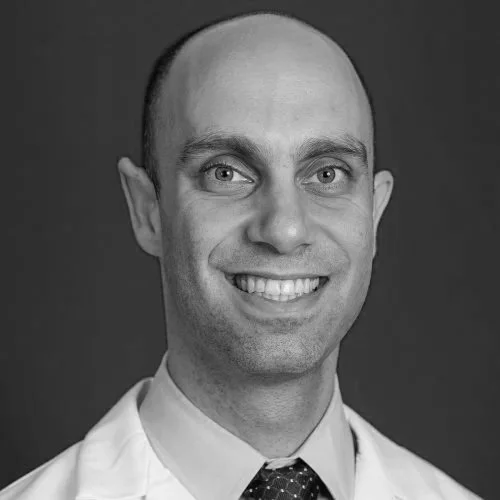
Adam Baruch, MD
Told him about the future that I had imagined for him. Imagined tickling him and hearing him sing and hearing him babble and watching him learn to walk and standing under the chuppah at his wedding. Imagine kind of this whole, the whole future that probably many parents imagine for their children. And that was totally gone.
As we were grieving, we were surrounded by so much love. My in-laws, Jerry and Louise, came in town, and my parents were there, my siblings were around us. We had friends who came by to support us. We were surrounded by a lot of love, but at the same time, we were just, we were very broken. Kind of like the dream that we had imagined for this child was totally gone. And obviously there were kind of repercussions for that for us, as far as what our… what we dreamt for our marriage, what we dreamt for our future family, questions about would we be able to have a family.
As time passed, we realized that we should go back to the doctors and see like what what happened, what was going on. So we ended up scheduling a visit with Dr. van de Ven, who was the head of the MFM division. And he said, you know, we need to do some more testing. And when that testing came back, it turned out that Tali has this uncommon and pretty terrible acquired thrombophilia, like a clotting disorder, called antiphospholipid antibody syndrome. And in addition to causing blood clots in the legs and the lungs in different places, it can also cause pregnancy complications. And so not only was the pregnancy at risk, but also Tali's health was at risk and continues to be at risk.
As we learned about that, we started kind of reflecting that there was a time in the pregnancy where Tali would forget things that seemed obvious. Like she'd say something and 15 minutes later she'd say it again. And we just we decided that it was worth seeing a neurologist. We saw a neurologist, Dr. Zahuranec, who ordered brain imaging and we were able to find out that Tali had some strokes or possible strokes. Because it's a clotting disorder, she saw Dr. Bockenstedt, who is a hematologist. And then we ultimately met Dr. Knight, who is, uh, all these people are our heroes, but we saw met Dr. Knight, who is kind of maybe the one of the MVPs of the hero list. This team was just incredible as far as kind of like supporting us, making sure that we felt cared for.
A joke that I showed up, we showed up at Dr. Zahuranec’s office and he told us, you guys are VIPs, we're going to take good care of you. We showed up at Dr. Bockenstedt’s office. She essentially told us, you guys are VIPs, we're going to take good care of you. We showed up at Dr. Knight's office, he told us you guys are VIPs, we're going to take good care of you.
Around that time, I graduated from residency and Tali and I were lucky enough to get into our Prius and drive for four months around the country. We drove out to Montreal and then all the way to the West Coast and down to California and then back up to Michigan. But while we were driving, it turned out that Dr. Knight told us about a research study for women who have antiphospholipid antibody syndrome that was done out at University of Utah by Dr. Ware Branch. A research study to see if they could improve the outcomes of pregnancies.
To state what might not be obvious is that we were terrified, absolutely terrified, of trying to get pregnant again, because the last time we had gotten pregnant led to what was our baby's death and strokes for Tali. And it was just kind of terrifying the thought of trying to get ourselves into that situation again. And Dr. Branch was nothing but gracious. We've talked to him on the phone many, many times. He shared with us kind of the science behind the research that he was working on. He shared with us the hope that he had. He shared with us information about why he was hopeful. He spent tons of time on… with us on the phone. I have this very these very clear memories of driving through Yellowstone talking with him. You can imagine that the service wasn't great, but he was patient when we lost each other.
So at least we had an idea that maybe if we tried again to get pregnant again that things might go better.
Fast forward to a few weeks later, and we were at Green Lake, which is outside Seattle, and Tali and I had like this major kind of breakdown as far as kind of conflict. Tali had this feeling that she wanted to be a mom and she dreamt of being a mom and she felt like she wanted to participate in the research study and wanted to try to get pregnant again. And I was just terrified. The thought of getting ourselves into that situation again, and that there was going to be potential for another terrible outcome, and that we would add more pain to the pain that we were already experiencing, was just terrifying to me. And she was really clear-headed. She had this kind of sense of, she had heard Dr. Branch out and she had a feeling of like it would be okay and that it was worth trying and that she dreamt of being a mom and this was the path towards becoming a mom.
And I wish I could say that I, you know, I just trusted her and we went with it. But we ended up kind of like separating and walking different ways around the lake. And it was a point of like major tension, just kind of the fear and the hopes and the dreams kind of all mashed together.
Over the course of the next several weeks, Tali’s hope and optimism won me over. And we decided to try to get pregnant.
And so we're staying at a hotel. In somewhere in like Arizona, I think. Tali went down for the breakfast. I think it was like a Marriott. So there was like breakfast downstairs. So she was downstairs and I woke up in the room by myself and I went into the bathroom to brush my teeth and I saw a positive pregnancy test sitting there.
That was amazing.
Around that time we drove back to Michigan and got ourselves settled and connected with Dr. Knight, and Dr. Knight had a big research team that was helping to collaborate on the research with Dr. Branch.
I was a bundle of nerves. But Tali was strong, like incredibly strong.
Over the course of the next nine months, 10 months, she went through a million hardships with a strength that is to this day unbelievable to me. That was about eight years ago. She had to give herself a million shots. She had to be on a blood thinner called Lovenox. She was giving herself this experimental medication called Cimzia that's not experimental for other things, but is experimental for antiphospholipid antibody syndrome. Because she was participating in this research study, she had a million blood draws. Together, we had a million sleepless nights. She had a million doctors' appointments. There was tons of monitoring throughout the pregnancy. There was concern about was there any impact on her brain? She had MRIs, she had all sorts of different kinds of things.
We had a million moments of tension. Tali was amazing. She kind of guided us through those. And then when we got to around 36 weeks into the pregnancy, we went in to see Dr. van de Ven, who took amazing care of us throughout the pregnancy. And he did an ultrasound and he said that he thought that there was oligohydramnios, that the fluid was on the low side, and that it was time to have the baby.
And I was scheduled for a hysterectomy that morning… to perform a hysterectomy that morning. And he said, that's fine. Tali should go home and collect her stuff, and I should go to the hysterectomy, and then we should come up to labor and delivery.
And so you can imagine that I tried my best to kind of re-center myself for that hysterectomy to take care of the patient who I was taking care of. And then we when that all ended, we ended up going up to labor and delivery.
When we were admitted, we were admitted kind of like I don't even know how to describe it, the feelings of kind of joy.
I think that that labor and delivery is a place of great joy, but because the people who were there knew our stories, these were my friends and people I trained with and people that I was training, people that I've been close to for many years. When they welcomed us onto labor and delivery, there was this feeling of kind of like we had made it together, that this was a big moment.
Thank God the induction went really smoothly and really quickly. Sometimes inductions can be long. And when it was time to give birth, when our baby was about to be born, the room filled up with people from labor and delivery, all these nurses and friends and doctors and all these people who were taking care of us and had been cheering us on and had been covering for me so that I could go to Tali’s ultrasounds and not stress test and all these other kinds of things.
And it was just incredible. Our baby was coming out right as the sun was rising. There was this feeling of like hope and optimism in the room. Looking around the room, it was like the faces of people that we loved, people who had supported us, people who had really gotten us through to this moment. And there wasn't a dry eye in the room. Everybody was kind of tearful and cheering and crying. It was just kind of like this incredible kind of incredible moment. Dr. van de Ven, who would probably deny this, kind of sat in the corner on a rolly stool. He was just kind of taking it all in. There were tears in his eyes.
Other times, in the future, people would ask me, did you deliver your son? Because I am an OB. There was no way I could have delivered our baby.
It was just like this moment that was kind of out of this world, holding Tali’s hand, seeing our son kind of coming out, seeing our son on Tali's chest, seeing our son crying out for the first time, with lungs that were working, with cardiovascular system that was working.
This beautiful little boy with 10 fingers and 10 toes.
Who would have a future of learning to crawl
and learning to walk
and learning to sing
and learning to read
and learning to be a brother
and learning to be a son
and learning to be a friend.
God willing, one day I'll stand with him under the chuppah at his wedding. He has a bright future.
But that sacred moment, when I stood there, in a time when I didn't even know if I didn't know if what was happening could it happen. And it happened.
This moment of life, this moment of renewal, this moment that was full of potential and full of future.
When I was asked to share a sacred moment, that's my sacred moment.
I have the incredible, incredible, incredible merit, the incredible joy of being with other people in their sacred moments when their babies are born. Also being in moments of great hardship with others. And by no means do I imagine that when other people are having their sacred moments, that it has anything to do with my sacred moment.
But I think having had a sacred moment, it helps me understand what it what it means, what it meant to us, what it meant to me, what it meant to Tali, what it meant to our families, what it meant our communities.
And so when I'm standing on the other side, when I'm the OB in the room, it helps me understand kind of just the magnitude of how huge these moments are. The moments of joy, the moments of suffering, the moments of pain, the moments of hope.
I want to close with a comment from Rabbi Sacks, a quote from Rabbi Sacks, who's a Rabbi who has a big impact on my thinking. That I shared I shared this quote at our son Matan's briss, at his baby naming ceremony. Rabbi Sacks said, “Time is not a series of moments traced on the face of a watch, always moving yet always the same. Instead, it is a journey with a starting point and a destination. Each moment has a meaning, which can only be grasped if we understand where we have come from and where we are going to.”
Thank you for listening.