
The Shattered Mask
There’s a particular kind of tired that comes with medical training. Not just the tiredness of lost sleep — though that is real, and it accumulates in the body like sediment — but a deeper fatigue, the fatigue of the unknown, of being perpetually unfamiliar. I have a feeling this description resonates with any medical trainee listeners (and those that used to be trainees). Every room, a new room. Every attending physician, a new set of unspoken expectations. Every situation, a test you haven't quite studied for. I would wake up for a 30-hour call day and think: what will today ask of me that I don't yet know how to give?
I was a first-year internal medicine resident, and I was on a rotation in the medical intensive care unit. I was twenty-something years old, newly minted, with a medical doctorate degree that suddenly felt very theoretical, caring for some of the sickest people I had ever been around. I wasn’t just nervous. I was petrified. And feeling just a touch sorry for myself.
And into that milieu of fatigue, fear, and unknown entered a woman I will never forget.
She was in her 50s, and she had been living with a disease called ALS — amyotrophic lateral sclerosis, sometimes called Lou Gehrig's disease. ALS is a cruelty that needs to be understood, because it is a very particular kind of cruelty: it strips the body of its physical functions while leaving the mind intact. The nervous system is like an electrical grid. In ALS, motor neurons – the cells that carry the brain’s instructions to muscles – begin to deteriorate. Using the electrical grid analogy, these motor neurons are the power lines to specific "appliances" (muscles). Initially, a localized outage of downed “power lines” might affect a single hand or foot, making it difficult to grip objects or walk. Over time, as the sclerosis spreads and more motor neurons go down, the blackout rolls across the whole body. Eventually it affects the muscles that allow one to swallow, to speak, to breathe. All the while, the person inside can watch, understand, and feel everything.
This woman had been living in that rolling blackout for years. She had weathered one complication after another. She had had infections and skin breakdown on pressure points. She had undergone a surgical tracheostomy — a small opening at the base of her throat, through which a tube connected her to a ventilator, a life-sustaining breathing machine that caused her chest to rise and fall like the rhythm of the tides. She was in the hospital again, this time with an infection that had proven to be stubbornly resistant to treatment. And she was awake. Awake and very aware, with sharp eyes that conveyed everything her body couldn’t articulate.
It was on one of my call days that she made the decision to remove the ventilator.
With her lungs and breathing muscles too weakened to sustain her on their own, removing the breathing tube meant she would die. She knew this. Her family and we (as her medical team) knew this. And she had decided, with a clarity that I found both awe-inspiring and terrifying, that she would die on her terms: in comfort, surrounded by the people she loved, without the machine. This is called a palliative extubation. It’s a sanctioned, compassionate act of medicine, honoring a person’s right to define the terms of their own passing.
We prepared carefully — the bedside nurse, a woman with decades of experience who saw my worry and doubt and questions and took me under her wing with a kind of wordless generosity I will never forget — we prepared the medications that would help to keep our patient comfortable, the protocols that would ensure her dignity.
And I prepared something else, too. I began to create a mask.
Not a literal mask but a figurative one. You may have seen this mask before—doctors wear it, teachers, survivors of trauma, parents wear it in emergency rooms when they strive to keep their children from seeing their own fear.
My mask was like that. Stoic. It was fixed, and knowledgeable, and unshakeable. It said: I know exactly what I am doing. You are in safe hands. There is nothing to worry about. I even rehearsed putting on my metaphorical mask, rehearsed what I would say when the time came.
Her family and friends began to arrive. They came in a procession, and so much was shared: long hugs and tears and sorrow and stories. But this procession of beloved people also brought with them something I was not expecting: They filled that room with stories and laughter and joy. They spent all day with her. And I moved at the edges of it, attending to the clinical details, practicing in my mask, observing.
Then the procession began to thin. She asked for just her closest family for the final moments. And there was a pause — a breath — a stillness in the room. And for just a moment, it was the two of us.
I had practiced for this. I put on my mask and felt it settle into place. And I looked at her.
She looked back at me… and smiled.
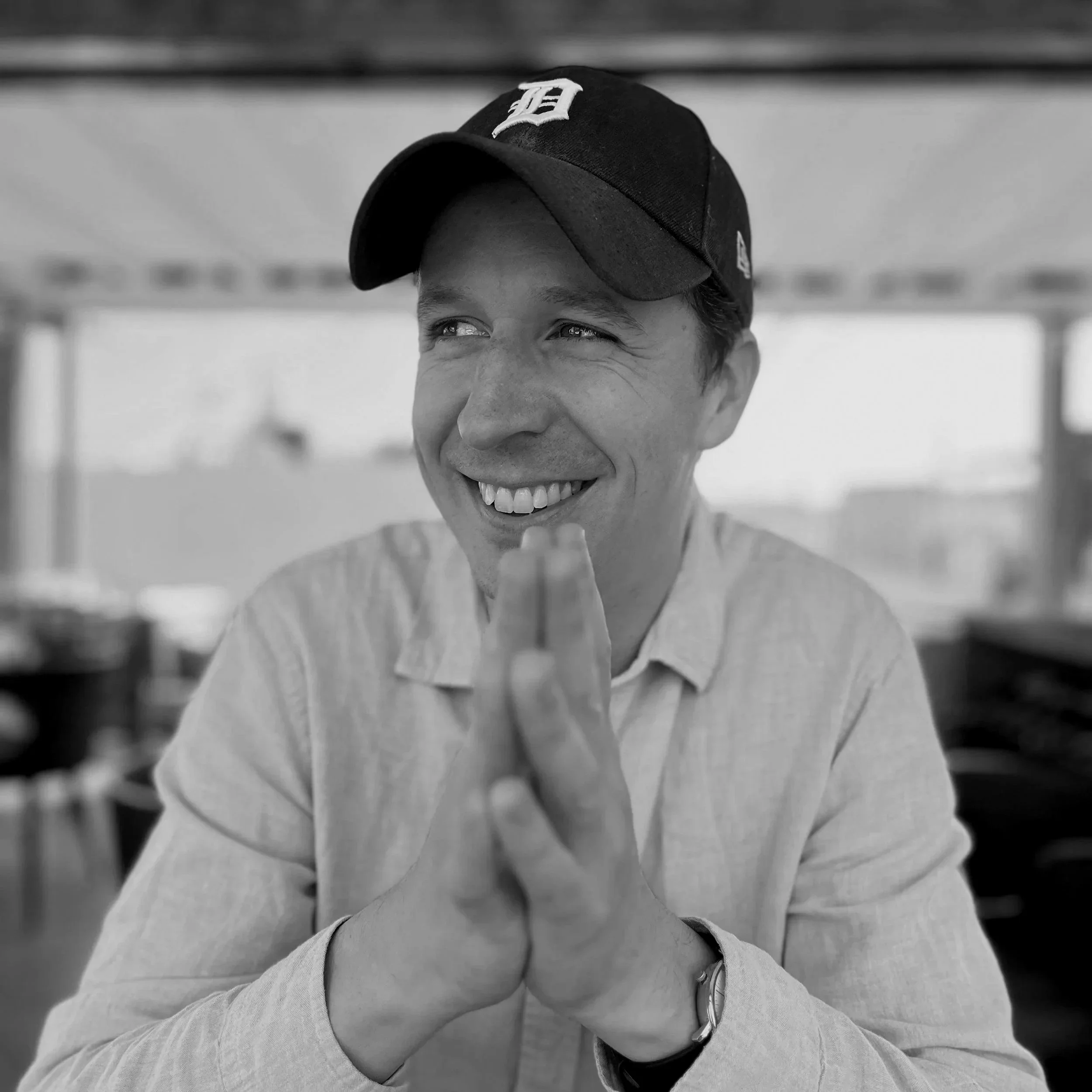
Nathan Houchens, MD
And the mask felt wrong. Heavy. Ill-fitting, like something I had borrowed that was never really meant for me. Because she was looking into my eyes — that one small opening where a mask can never fully conceal — and what she found there was not stoicism. It was not certainty. It was not the steady knowledge of a doctor who has done this a hundred times before.
What she found there were my worried eyes silently asking: Are you sure?
She smiled again, reached out, took my hand, my cold hand, with all its dried layers of hospital soap. She took my hand in hers and squeezed it. She nodded, and even though no words were spoken, I knew she was telling me that everything was going to be all right in whatever ways that meant to us both. She nodded as a single tear slid down her cheek.
The world rearranged itself in that moment in a way I’m still grappling with and trying to describe, some 20 years later. Because I was supposed to be caring for her. I was the physician. I had the chart, the training, the white coat. And this woman — who had carried ALS in her body for years, who had endured more than I could ever imagine, who was moments away from the end of her life — this woman was consoling me.
The mask didn't slip. It didn’t splinter. It shattered. It lay next to my tears on the floor of that hospital room, in pieces, and I found myself standing there without my façade, just a naïve new doctor and a dying woman.
The alarms and beeps of the ICU — that relentless chorus — began to recede, softening at the edges, until it felt like they were coming from somewhere very far away. In the back of my mind, I noticed that my fatigue had washed away too.
And in that stillness and quiet, I saw her.
When I say that, I mean that I really saw her. Wreathed in something I don't have the right words for. She seemed to me radiant, luminescent.
Now — here is where the two parts of my brain begin to argue with each other, because I am a physician after all, and physicians are trained to find explanations, to find capital T truths.
There is a phenomenon in neuroscience called the Troxler effect. You may not know it by that name, but if you've ever looked through the cardboard tube of a paper towel roll or experienced tunnel vision — that narrowing of the world to a single point of focus — you've experienced something like it. The Troxler effect is a perceptual illusion in which objects at the periphery of your visual field begin to fade, and eventually vanish entirely, when you fix your gaze on a central point for long enough. It’s because the brain adapts and treats those peripheral objects as redundant, unnecessary, and simply stops processing them. They fade and dissolve.
The analytical part of me wonders if that’s maybe what happened. That I had locked eyes with my patient so completely, so intently, that my brain simply let everything else go. The monitors faded, the walls faded, the fluorescent lights faded. And in that perceptual narrowing, she appeared to shine — not because she was really shining, but because my brain had edited out every competing source of light.
That’s one possible explanation.
But there is another part of me — the part that stood in that room and felt something shift in the air, something I didn’t learn in medical school — that part of me wonders if what I witnessed was something older, something that doesn’t have a name in any clinical textbook I ever read.
I wonder if I witnessed transcendence.
I don't know how to reconcile those two explanations. I'm not sure I can… or even want to. Because maybe the most honest thing I can say is that they are not mutually exclusive. Maybe the Troxler effect made room for something more profound and ethereal that was already there. Maybe science can put a name to tunnel vision without needing to explain the source of the light that remains.
What I do know is that I walked into that room in a carefully constructed mask, and she — with a look, a squeeze of the hand, and a reassuring smile — gave me a lasting gift. She showed me that sometimes the most powerful thing a physician can do to connect is to stop performing strength and instead embrace authenticity. Imperfect. Afraid. Real.
The ventilator was removed, as she had wished, with dignity and surrounded by those she loved most in this world.
I carry her with me still. Not just in my memory, but in the way I try to show up with patients now — the way I let the mask stay on the floor. The way I remember that in medicine, as in all other aspects of my life, the moments when we are most fully human are often the moments when we show our true faces with each other.
She gave me that gift.
A woman I had barely come to know, in the final hours of her life — she gave me that, and I cherish it to this day.